
Investment Research & Due Diligence
Veris uses a dual lens to evaluate managers and strategies across public and private markets for financial merit and impact integrity.

Financial Merit and Impact Integrity
We believe that impact and financial performance are not in tension and our research process was designed to evaluate strategies through both lenses, examining their potential to deliver returns consistent with their asset class, and the authenticity and depth of their impact. This dual focus runs through our work in public markets and alternative investments alike. Impact is not a screen we apply at the end; it is foundational to how we select, monitor, and re-evaluate managers over time.

The Veris Investments Team
Led by Veris CIO Roraj Pradhananga and Managing Director Eric Hsueh, our firm’s Investments team members are seasoned researchers who cover multiple asset classes and continue to expand their specialization in specific asset classes or aspects of impact investing including impact measurement and management.
The Veris Due Diligence Process
We evaluate managers and strategies through a holistic framework examining six dimensions. Our Investments team’s findings are reviewed and approved by our Investment Committee.
We assess firm ownership, team diversity, experience, and key-person risk — who holds decision-making power, and who sits at the table.
We vet the authenticity of a manager’s mission orientation and impact thesis, looking for genuine conviction rather than marketing.
We analyze the full decision chain, from universe and security selection to the integration of sustainability factors and risk controls.
We seek consistent risk-adjusted returns relative to benchmarks, typically expecting a three-year track record for public managers, with exceptions for emerging managers.
We examine the implementation details that affect clients directly: investment minimums, custodial availability, fees, and terms.
We assess the depth of a manager’s impact measurement and management — use of standards like IRIS+ and the Impact Management Project’s five dimensions, and whether they engage in active shareholder advocacy rather than relying on screening alone.

Research in Public Markets
In public equity and fixed income, we scrutinize a strategy’s sustainability objectives, methodology, risk management, and reporting alongside rigorous financial analysis. We look closely at whether a manager actively engages (voting proxies, filing resolutions, and pressing companies on material issues). We believe lasting change in public markets comes through active ownership, not screening alone.

Research in Alternative Investments
In private markets and alternatives, our diligence deepens. We assess a fund’s impact thesis, additionality, measurement standards, and potential for unintended consequences alongside its governance (manager diversity, fee alignment, and transparency). This is also where we evaluate Community Development Financial Institutions (CDFIs), impact-first investments that channel capital to communities conventional markets often overlook.
Diligence Doesn’t Stop at Approval
Our Investments team and Investment Committee monitor approved strategies continuously and re-evaluate them on a fixed schedule.
Quarterly Monitoring
Each quarter we track public managers against their benchmarks, review private fund performance and holdings for thesis alignment, and watch for changes in strategy or key personnel.
Annual Re-Evaluation
Annually, we re-assess managers with updated questionnaires and re-classify them for diversity and thematic alignment (looking for signs of mission-drift).
Safeguards Against Impact Washing
To guard against impact washing, we run data-validation checks that flag anomalies and year-over-year deviations in reported impact metrics, and we verify material changes as they happen. Managers who fall short are placed on a watch list for potential removal.
Veris Frameworks
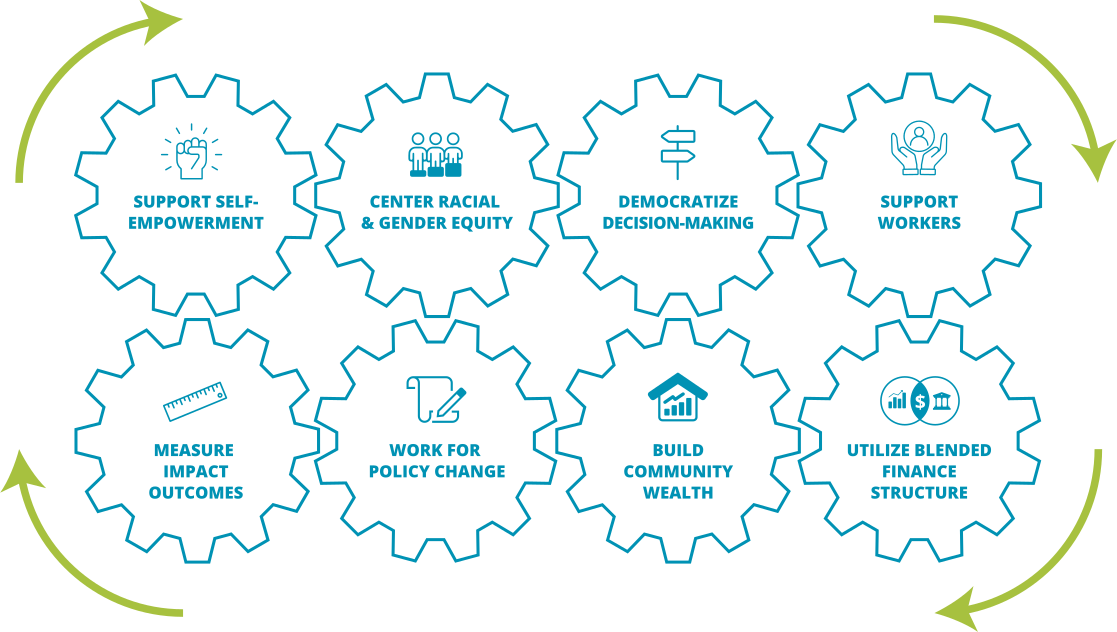
Investing in a Just Transition
A framework Veris developed to help our firm identify climate solutions that intentionally address the disproportionate harm of the climate crisis on under-resourced communities.
Veris Frameworks
Our equity, diversity, and inclusion (EDI) framework and framework for investing in a just transition are detailed in these reports.

Put our process to the test
Consultants and prospective clients are welcome to dig into our methodology. We’re glad to walk through how we evaluate managers across asset classes.